Moving to Vulkan was never about drawing the same picture in a new way. It was about reaching the parts of a modern graphics card that OpenGL cannot touch. Within a week of the first Vulkan frame, the remastered preset was using three of them. The retail-faithful preset draws none of this; it keeps the console's picture.
Shadows that know where the buildings are
The games' own shadows come from a shadow map, which only knows about the cars and the characters. The level itself casts nothing. Drive a car into the shade of a building at noon and the sun's highlight kept shining on it, straight through the wall.
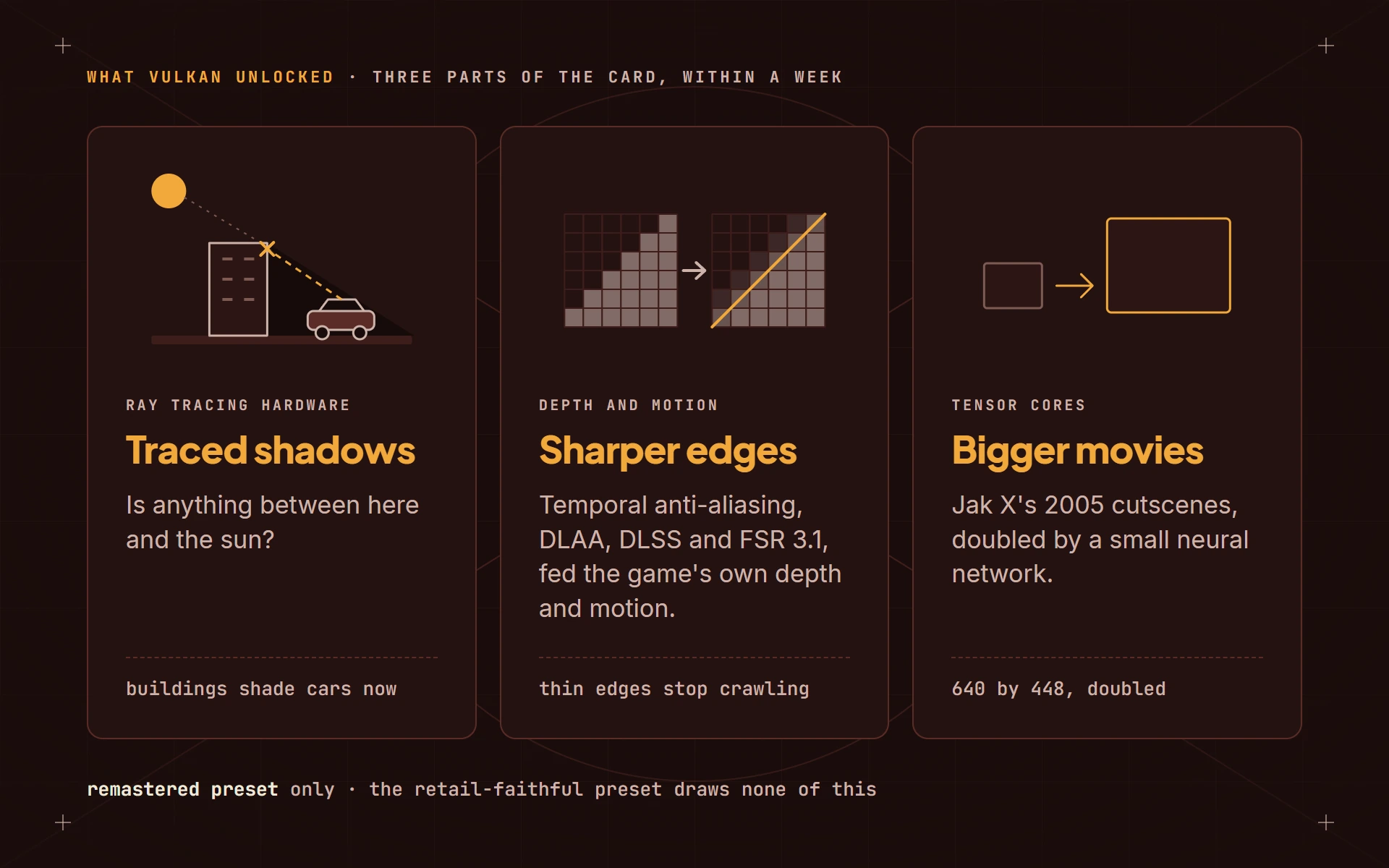
Ray tracing fixes that by asking the card's ray tracing hardware a simple question for each point on screen: is there anything between here and the sun? The foundation went in on September 19th and traced sun shadows on September 21st, off by default and in Jak X first.
The first version had a funny flaw, found by driving: the shadows faded away whenever the car drove under a building. The new pass had borrowed the old shadow system's check for whether something was under cover, and that check was answering a different question. It was replaced.

Sharper edges, more pixels
PlayStation 2 geometry shimmers on a modern screen: thin edges crawl as the camera moves. Over two days the remastered preset gained a temporal anti-aliasing pass, then NVIDIA's DLAA and DLSS, called directly through NVIDIA's own library, then AMD's FSR 3.1, which runs on any vendor's card.
These need two things from the game: how far away each pixel is, and how it moved since the last frame. An emulator like PCSX2 has neither, which is why its attempts at FSR never stuck. Phaethon runs the game's own code and knows both.
For now their controls live in the debug window, with menu rows on the way. Ray Reconstruction and Frame Generation were left out on purpose until known Vulkan bugs in them are fixed.
Bigger movies
Jak X's cutscenes are pre-rendered videos, made at 640 by 448 in 2005. On September 23rd the game gained an optional upscaler for them: a small neural network that doubles each frame's size while you watch. A first pass cleans out the blocky marks of the old video compression, then the network does the rest.
The network is 2xNomosUni_compact_multijpg_ldl by Philip Hofmann, used under its CC BY 4.0 license. Written as an ordinary shader it cost 19 to 22 milliseconds a frame, too slow to keep up. Rewritten for the card's tensor cores, the parts built for neural networks, it costs 7.5.
Next: a relit world
The biggest piece is still in progress. In the remastered preset the world is starting to be lit by the game's own lights (the sun, the sky, lamps, fire, light bouncing off walls) instead of only the lighting the artists painted into the models. That story gets its own post when it lands.
Alex (maintainer, and a mechanical engineer by trade)