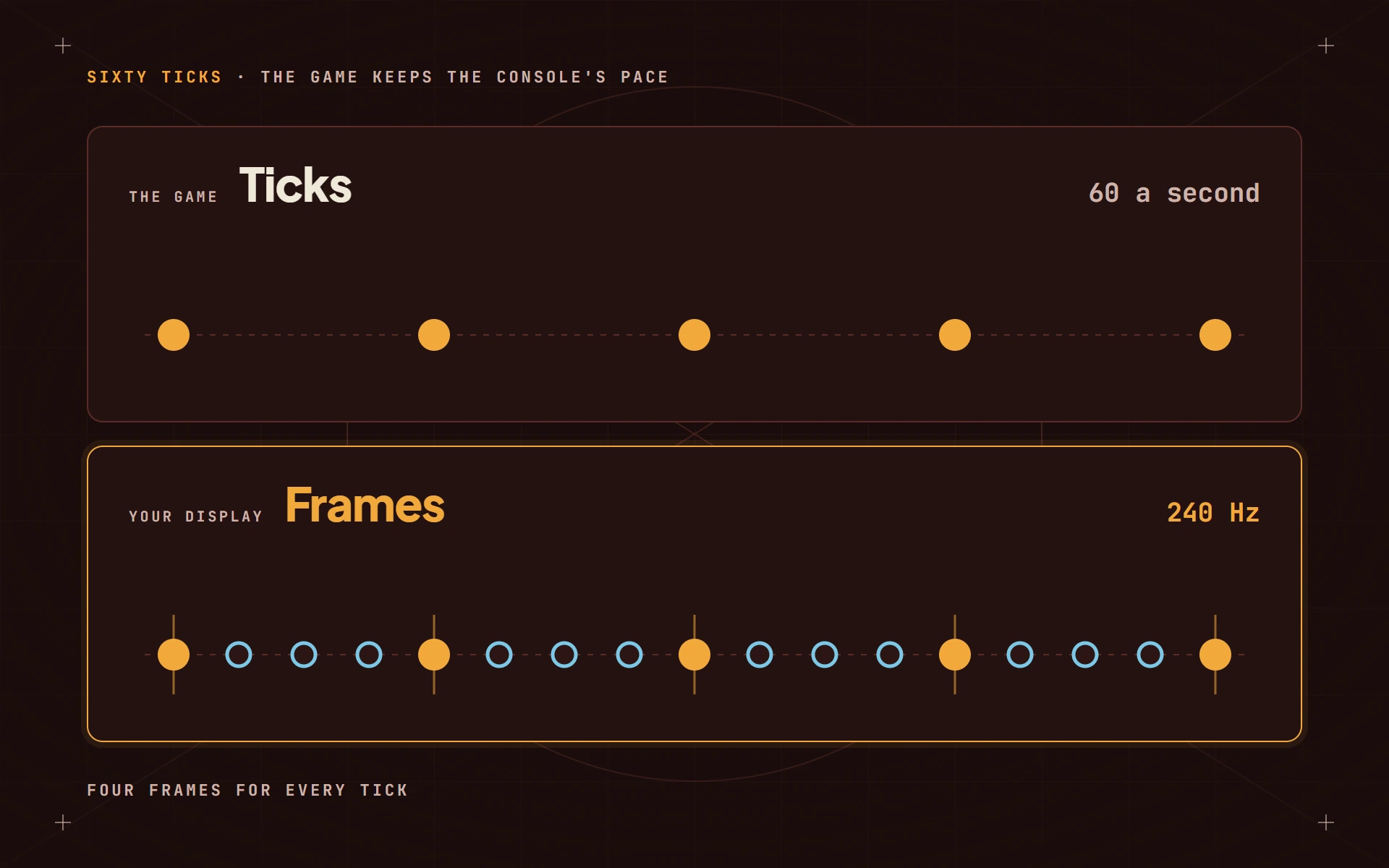
A game does two different jobs many times a second. It updates the world: it moves Jak, checks what he hit and counts down every timer. And it draws a picture of that world on the screen. On the PlayStation 2 the Jak games updated their world once for every field the television drew, sixty times a second, or fifty on PAL sets. Each of those updates is a tick, and the console never took one shorter than that.
Everything in the games' code is written for that pace. How high a jump goes, how a platform moves, how long an enemy waits: all of it assumes the console's ticks.
Faster is not smoother
OpenGOAL offers 100 and 150 frames a second in Jak and Daxter, and up to 240 in Jak II and Jak 3. To get there it runs the whole game faster, ticks and all, and then patches by hand each piece of logic that breaks when it does. Jak and Daxter carried 50 of those patches, Jak II 14 and Jak 3 29, and every new bug found at high frame rates meant another one.
Phaethon took the other road. Every game's logic now runs at the console's rate in every preset, and on October 3rd the patches came out: all 93 of them, because nothing runs fast enough to need them. Taking out the old frame limiter also fixed something nobody had pinned down: the PAL versions of the trilogy had been running a fifth too fast.
Smooth at any refresh rate
A fast screen still deserves a smooth picture. The remastered preset now draws at your display's own rate, whether that is 144 Hz or 240 Hz, and fills the frames between two ticks by blending the camera and the characters between where they were and where they are going. The game keeps the console's pace while the picture follows the screen.
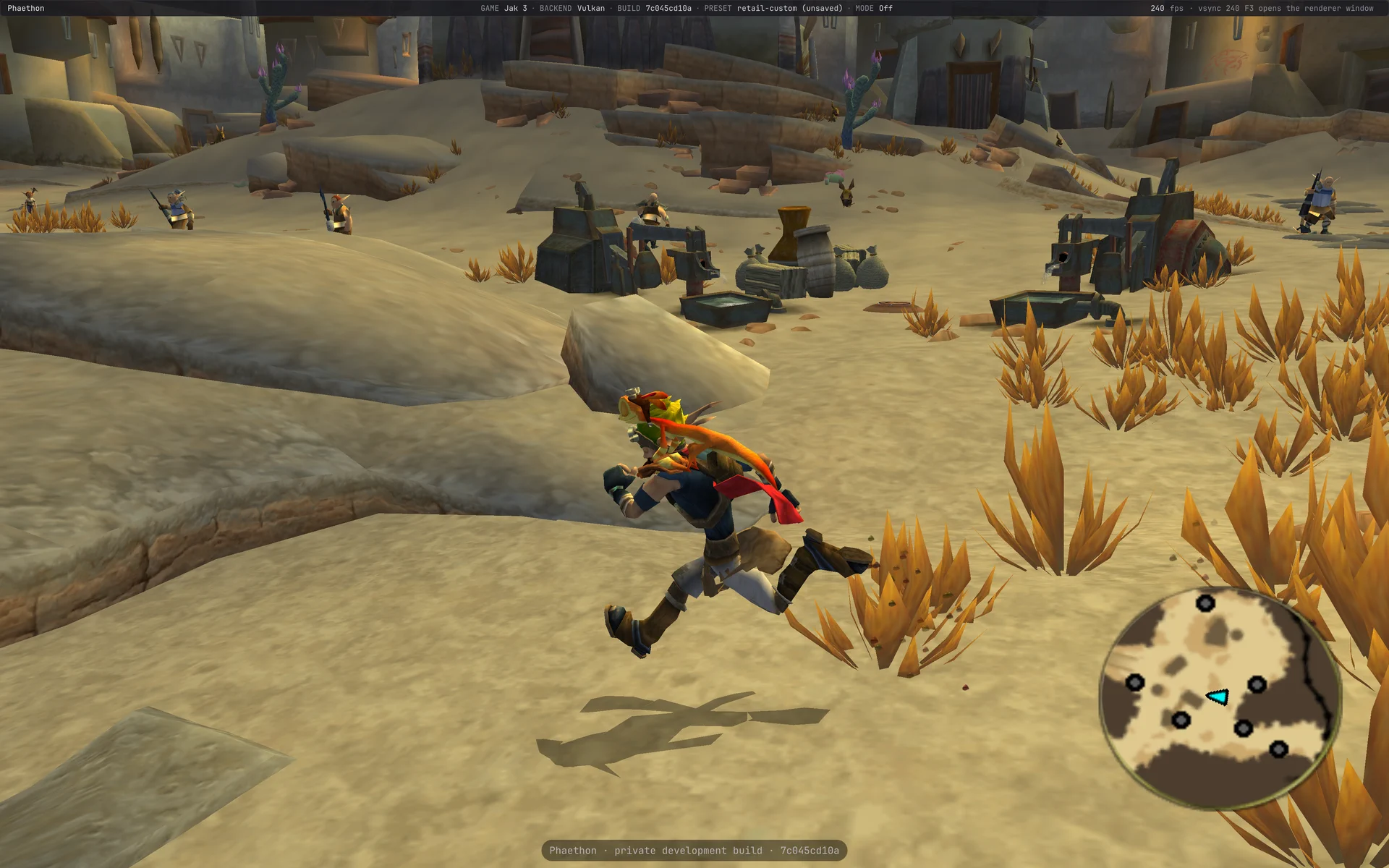
The blend had its own teething troubles, each found and fixed along the way: a fast wheel that seemed to spin backward, limbs stretched for a single frame, shadows that twitched, and a game that booted at half speed on a 240 Hz screen until you switched away and back.
What still steps at sixty
Not everything is blended yet. Particles, the ocean and animated textures still move once per tick, so on a fast screen they step while the camera and characters glide. A present mode setting replaced the old frame rate option.
Alex (maintainer, and a mechanical engineer by trade)